BPC-157
0.5 mgG1E2P3P4P5G6K7P8A9D10D11A12G13L14V15
- Molecular formula
- C62H98N16O22
- Molecular weight
- 1419.5 g/mol
- CAS number
- 137525-51-0
- PubChem CID
- 9941957
- Length
- 15 aa
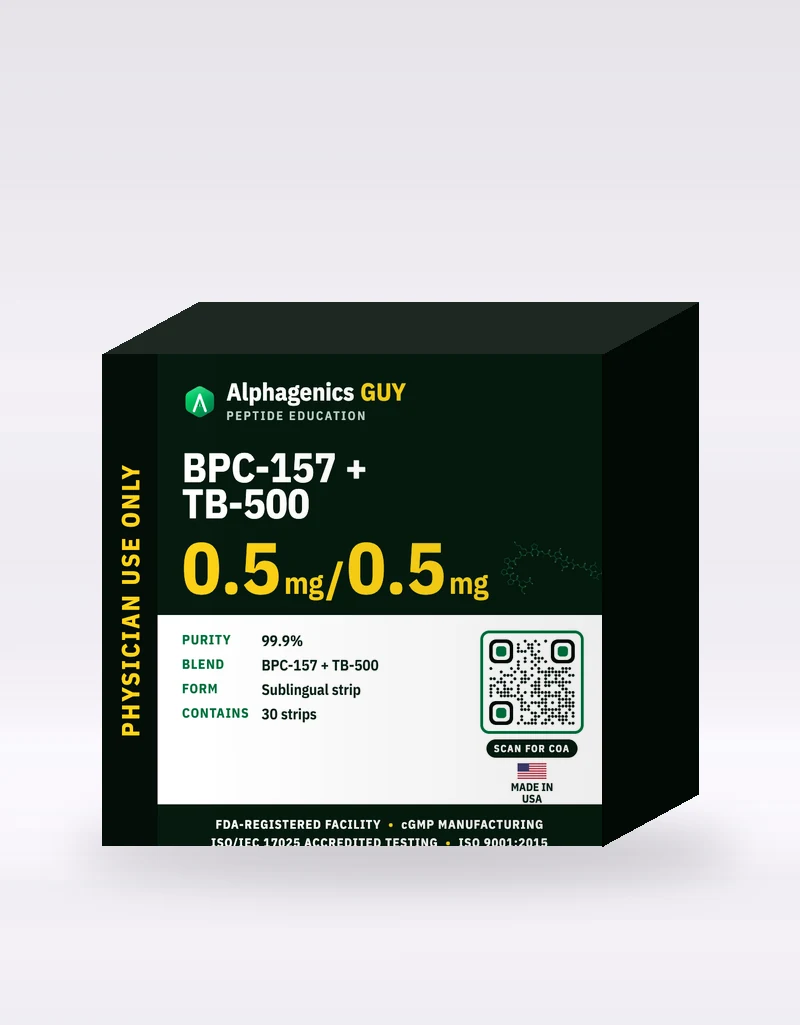
BPC-157 + TB-500 · Sublingual dissolving strips
Combination of research peptides in tissue recovery, in sublingual dissolving strips
This sublingual dissolving-strip presentation combines two peptides studied mostly in animal models of tissue injury.
BPC-157 is a synthetic pentadecapeptide whose sequence derives from a protein in gastric juice, described as stable in the gastric environment. Two molecules are sold under the name TB-500: the synthetic N-acetylated fragment Ac-LKKTETQ (thymosin β4 sequence 17-23, short chain) and full-length 43-amino-acid thymosin β4 (long chain); the form present in each lot is stated on its certificate of analysis, and each finding states which molecule was studied. No published studies of sublingual or oral-film delivery of either peptide, or of the combination, were found: the evidence comes from studies of each peptide by other routes.
Reference amounts of the formulation. The physicochemical data correspond to each individual peptide.
Summary of results reported in the scientific literature. Each finding describes what was observed in the cited study, in its specific population and conditions; it does not constitute a therapeutic indication.
BPC-157: in rats with surgical transection of the medial collateral ligament, BPC-157 given orally in drinking water, as well as intraperitoneally or as a topical cream, has been associated with functional, biomechanical, macroscopic and histological improvements in ligament healing.
Cerovecki T et al. J Orthop Res. 2010;28:1155-1161 · PMID 20225319BPC-157: in rats and beagle dogs, after intravenous or intramuscular administration, the elimination half-life of intact BPC-157 was under 30 minutes; intramuscular bioavailability was approximately 14-19% in rats and 45-51% in dogs, and the peptide was rapidly metabolized into small peptide fragments and amino acids.
He L et al. Front Pharmacol. 2022;13:1026182 · PMID 36588717BPC-157: a 2026 review describes BPC-157 as unusually stable in gastric juice and active by oral, parenteral and topical routes in preclinical studies, but notes that no pharmaceutical formulation has been developed or validated, that no phase II trial has been completed, and that the available clinical data come from fewer than 30 subjects in three uncontrolled pilot studies.
Mateescu DM et al. Pharmaceutics. 2026;18:625 · PMID 42198317TB-500 (short chain and long chain): in aged mice (26 months) with full-thickness dermal wounds, full-length thymosin β4 has been associated with faster healing, with greater keratinocyte migration, wound contraction and collagen deposition; the synthetic heptapeptide LKKTETQ (the sequence of short-chain TB-500, without the N-terminal acetylation) promoted repair comparable to that of the full-length molecule.
Philp D et al. Wound Repair Regen. 2003;11:19-24 · PMID 12581423TB-500 (short chain, Ac-LKKTETQ): in its 2026 evaluation for the Pharmacy Compounding Advisory Committee (PCAC), the FDA identified no clinical or pharmacokinetic studies of TB-500 in humans by any route of administration and no in vivo wound-healing studies; it did identify an in vitro study in which TB-500 (50 µg/mL) did not induce wound closure in fibroblasts, whereas its metabolite Ac-LKKTE appeared to do so.
FDA. Briefing document, Pharmacy Compounding Advisory Committee, July 23-24, 2026: TB-500-Related Bulk Drug SubstancesThis sublingual dissolving-strip presentation combines two peptides studied mostly in animal models of tissue injury. BPC-157 is a synthetic pentadecapeptide whose sequence derives from a protein in gastric juice, described as stable in the gastric environment.
See each component
See each component
BPC-157: in rats with surgical transection of the medial collateral ligament, BPC-157 given orally in drinking water, as well as intraperitoneally or as a topical cream, has been associated with functional, biomechanical, macroscopic and histological improvements in ligament healing. (Cerovecki T et al. J Orthop Res. 2010;28:1155-1161, PMID 20225319) BPC-157: in rats and beagle dogs, after intravenous or intramuscular administration, the elimination half-life of intact BPC-157 was under 30 minutes; intramuscular bioavailability was approximately 14-19% in rats and 45-51% in dogs, and the peptide was rapidly metabolized into small peptide fragments and amino acids. (He L et al. Front Pharmacol. 2022;13:1026182, PMID 36588717)
Store in the original closed package, protected from light, heat and moisture.
0.5/0.5mg · 30 tiras